


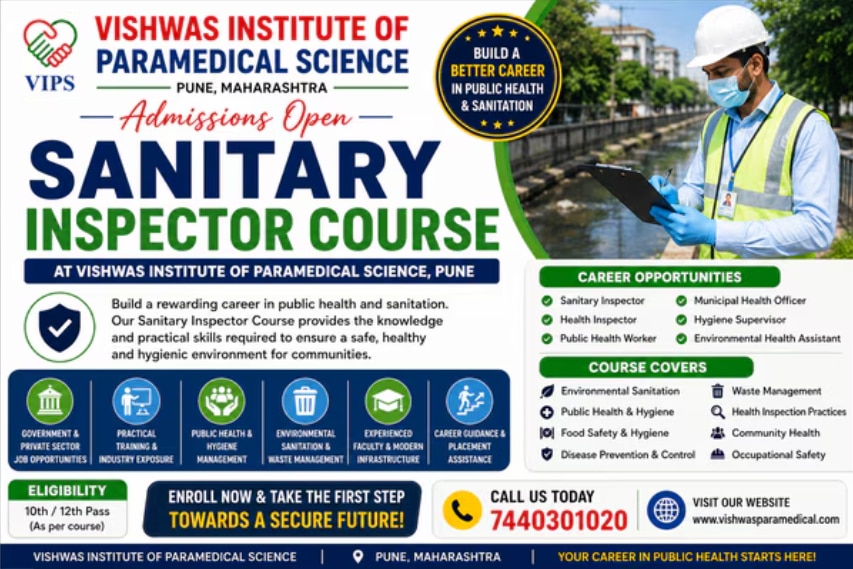
Before the rains, sanitary inspection shifts from routine observation to rapid control of stagnant water, blocked drainage, unsafe storage, contaminated supplies and public complaints. By the end, you will know which practical skills a course must teach, how to compare Pune programmes, and which documents to verify before enrolment.
Key takeaways
- Map flood-prone areas before heavy rain begins.
- Check stagnant-water containers, drains, toilets and waste points.
- Practise identifying leaking sewage and water lines in the field.
- Verify course recognition before enrolling in Pune.
What Does a Sanitary Inspector Do Before, During and After Monsoon?
Before the first heavy shower, a sanitary inspector maps flood-prone areas and checks stagnant-water containers, blocked storm-water drains, overflowing waste points, toilets, public buildings and leaking sewage or water lines. The aim is source reduction: remove mosquito-breeding sites, restore drainage and correct hazards before access becomes difficult.
| Monsoon phase | Field duties | Public-health risk controlled |
|---|---|---|
| Before | Inspect food premises, temporary stalls, waste storage, toilets and drinking-water sources; record defects and issue notices for correction. | Vector breeding, food contamination and unsafe water |
| During | Respond to complaints about waterlogging, waste accumulation, sewage overflow and flooded premises; inspect affected areas and use PPE when handling contamination risks. | Mosquito surges, diarrhoeal disease and exposure to sewage |
| After | Revisit repaired sites, check remaining containers and silted drains, verify water-supply safety and document unresolved violations. | Recurrent breeding, contaminated water and repeat flooding |
These duties explain why sanitary inspector training before monsoon must include environmental inspection, water and food hygiene, vector control, waste management, record keeping and public-health communication—not only hospital procedures.
A sanitary inspector course in Pune is not a single nationally uniform qualification: compare the awarding body, assessment, field visits, supervised inspection logs, sample handling and certificate number.
A course starting before the rains can build seasonal field skills, but it does not replace the qualification, registration or examining authority named in a municipal or state recruitment notice.
The Pre-Monsoon Field Checklist Every Learner Should Practise
A useful pre-monsoon checklist turns observations into dated actions. Carry a ward map, inspection form, phone camera, torch, gloves, gumboots and sample containers approved by the supervising laboratory.
1. Map low-lying streets, schools, markets, construction sites and flood-prone buildings. Mark blocked storm-water drains, damaged covers, overflowing waste points, leaking sewage lines and public toilets needing repair.
2. Inspect every likely mosquito-breeding site: tyres, buckets, roof gutters, tanks without lids, discarded containers and construction pits. Record the exact location, water presence, responsible person, photograph and source-reduction action.
3. Check drinking-water points, storage tanks, taps and nearby sewage lines. Note leaks, cross-connections, dirty containers and flood-contamination risks; collect samples only under the approved procedure and preserve each sample with its label, date and time.
4. Visit food stalls and markets. Record uncovered food, unsafe wastewater disposal, missing handwashing facilities, poor refuse storage and temporary structures that could become unsafe during heavy rain.
5. Write each finding in a log with inspection date, risk, notice or instruction issued, responsible department and follow-up date. Revisit unresolved drains, waste points and breeding sites before rainfall intensifies, then escalate overdue work to the supervisor.
A sanitary inspector course in Pune should practise these tasks through supervised field visits, PPE use, sampling, inspection logs and notice writing. While comparing healthcare courses in Pune, ask whether practical records and assessment come from a named awarding body; a seasonal workshop alone cannot replace a qualification or government recruitment requirement.
What a Complete Sanitary Inspector Syllabus Should Include
A complete syllabus pairs public-health theory with supervised evidence from the field. A sanitary inspector certificate course should cover environmental sanitation, public-health legislation, food hygiene, drinking-water safety, sewage and drainage, latrine assessment, solid-waste management, vector control, epidemiology, health education, occupational safety, and record keeping.
Look for training that requires learners to:
- Conduct sanitary surveys and map stagnant-water, waste, drainage, and flood-contamination risks.
- Collect, label, preserve, and document drinking-water samples under supervision.
- Inspect food premises, public buildings, toilets, drains, waste-storage points, and mosquito-breeding sites.
- Complete inspection logs, write reports, prepare notices or referrals, and explain corrective action to households and establishments.
- Use gloves, boots, masks, disinfectants, and safe sampling procedures without treating or diagnosing patients.
A public health sanitation course in Pune is useful only when its practical work is assessed, not merely described in a prospectus.
| Syllabus area | Supervised evidence | What classroom-only training misses |
|---|---|---|
| Water and food hygiene | Sample handling, food-premises inspection, documented findings | Contamination risks and chain-of-custody errors |
| Drainage, latrines and waste | Site inspection, measurements or observations, follow-up log | Whether defects persist after a notice |
| Vector control and epidemiology | Identify breeding sites, record cases or complaints, plan action | The difference between a hazard and a response priority |
| Communication and records | Household education, report writing, notice or referral exercise | Clear instructions and legally useful documentation |
| Safety and assessment | PPE use, field log review, named assessor’s feedback | Whether you can perform the duty independently |
How These Pune Course Types Differ
Titles overlap, so the name alone cannot tell you what you will be qualified to do. A sanitary inspector course in Pune is usually the most role-specific option: it should prepare you for sanitation inspections, disease prevention, documentation, public communication and field action, not clinical diagnosis or treatment.
| Course type | Main focus | What to verify |
|---|---|---|
| Sanitary inspector course in Pune | Water and food hygiene, drainage, latrines, waste, vectors, public-health law and inspection reports | Named awarding body, syllabus, supervised fieldwork, assessment method and certificate number |
| Public health sanitation course in Pune | Broader community sanitation, including sanitary surveys, water sampling, food-premises checks and household communication | Confirm that practical inspections and sample handling are included, rather than classroom theory alone |
| Sanitary inspector certificate course | A shorter or narrowly assessed route carrying a certificate | Check duration, examination authority and whether the qualification appears in the recruitment notice you are targeting |
| Environmental-health qualification | Wider environmental controls such as pollution, occupational hazards, water quality and environmental regulation | Check whether sanitation inspection, municipal procedures and field documentation receive enough teaching |
A sanitary inspector certificate course does not automatically qualify you for a government post. Recruitment notices may require a particular examining authority, course duration, technical qualification, age limit or experience, so compare the certificate against the relevant municipal or state notification.
Use the Directorate General of Training Health Sanitary Inspector trade as a benchmark for content. A credible programme should show field logs, PPE practice, water or food-sample handling and inspection assessments; advertising that promises independent diagnosis or treatment signals the wrong course.
How to Verify Recognition Before You Enrol
A certificate title alone does not prove eligibility for municipal or public-health work. Ask who issues it, which authority examines students, and whether the programme meets the entry and assessment conditions stated in the vacancy notice you want to pursue.
| Document to request | What to verify | Warning sign |
|---|---|---|
| Affiliation or approval letter | Issuing authority, approval number, validity period, and course title | Staff show only a brochure or website claim |
| Sample certificate and marksheet | Exact certificate issuer, examination body, duration, practical-hours record, and marks awarded | The institute cannot show blank samples |
| Admission and eligibility sheet | Required education, science subjects, age rules, attendance, fees, refund terms, and examination schedule | Requirements are described as “open to everyone” |
| Practical-training plan | Locations and hours for water sampling, food-premises inspection, drainage and latrine surveys, waste observation, vector-site checks, and report writing | “Practical exposure” has no timetable |
Use the Directorate General of Training Health Sanitary Inspector trade as a syllabus benchmark, not as automatic recognition for a private course. It covers sanitation inspection, communicable-disease prevention, water and food hygiene, waste management, and fieldwork—not diagnosis or treatment.
Before paying, ask these questions in writing:
- Who conducts the final examination?
- Does the certificate qualify you for a named municipal recruitment route?
- Will you receive attendance and practical-hour records?
- Which supervisors accompany field visits?
- Can you inspect the laboratory, sampling equipment, registers, and completed report formats?
For healthcare courses in Pune, sanitary inspector training before monsoon can sharpen seasonal field skills, but timing does not replace a recognised qualification. Vishwas Institute| Best Paramedical Institute should be assessed using the same documents and practical evidence.
Related product
 | Paramedical Courses / Public Health & Sanitation Courses Sanitary Inspector Course – Vishwas Institute of Paramedical Science, Pune Build a rewarding career in public health and sanitation with the Sanitary Inspector Course at Vishwas Institute of Paramedical Science, Pune. |
Frequently asked questions
What does a sanitary inspector do before, during and after monsoon?
Before monsoon, the inspector maps flood-prone areas and checks stagnant-water containers, blocked drains, waste points, toilets, public buildings and leaking sewage or water lines. During and after monsoon, the inspector follows up on hazards, drainage failures and mosquito-breeding sites.
What should a learner practise in a pre-monsoon field checklist?
Practise inspecting stagnant-water containers, storm-water drains, waste points, toilets, public buildings and leaking sewage or water lines, while recording hazards that require correction.
What should a sanitary inspector syllabus include?
A complete syllabus should connect sanitation inspection with source reduction, drainage, waste points, toilet inspection, public-building checks, water and sewage-line hazards, and field reporting.
How can you verify recognition before enrolling in a sanitary inspector course in Pune?
Ask the institute for the awarding body’s name, the course approval or affiliation document, the certificate title and the authority that accepts it for the role you intend to pursue. Check that these details appear on official documents rather than relying only on promotional wording.