


A graduate’s subject background, comfort with clinical specimens, preferred work setting, and career goal all affect whether laboratory technology is the right next step. By the end, you can compare postgraduate and advanced routes, check medical laboratory technology course eligibility, and reject programmes that do not match your intended role or employer requirements.
Key takeaways
- Life-science graduates usually have the strongest foundation for advanced laboratory study.
- Choose postgraduate study for depth; choose DMLT when you need practical entry-level training.
- Confirm affiliation, hospital postings, laboratory facilities, and internship hours before enrolling.
- Choose imaging, nursing, or public health if routine specimen work does not suit you.
Does Your Graduate Background Match Laboratory Work?
A B.Sc. in Medical Laboratory Technology, Medical Laboratory Science, microbiology, biochemistry, biotechnology, zoology, or another life-science subject usually gives you the strongest foundation for advanced laboratory study. Graduates targeting hospital diagnostics, research, quality management, or technical supervision benefit most when they enjoy biology, chemistry, accurate measurements, and controlled procedures.
| Background or preference | Likely fit | What to verify |
|---|---|---|
| B.Sc. MLT or Medical Laboratory Science | Strong fit for advanced study and laboratory promotion | Whether the route accepts your exact qualification and registration documents |
| Life-science graduate changing into diagnostics | Possible fit through an approved conversion route | Required subjects, minimum marks, entrance test, and practical training |
| Commerce, arts, or unrelated degree | Poor fit for advanced DMLT unless the written rule permits it | Do not assume “graduate” alone satisfies eligibility |
| Dislike of specimens, repetitive records, or strict SOPs | Poor personal fit | Consider nursing, public health, or another patient-facing field |
Choose a medical laboratory technology course for graduates in Pune only after checking its written eligibility and practical facilities. You should expect supervised work with blood, urine, stool, swabs, and departments such as haematology, biochemistry, microbiology, blood banking, histopathology, and phlebotomy.
Laboratory work is not bedside counselling or independent diagnosis. You will process specimens, maintain quality records, flag critical results, and accept early, late, or urgent shifts. A preference for predictable daytime work or constant patient contact is a warning sign.
Which Qualification Route Fits Your Existing Degree?
Your existing degree should determine the route, not the word “graduate” in an advertisement. Check the institution’s current medical laboratory technology course eligibility, then match it against the qualification required for your intended job.
| Option | Best fit | Verify before applying |
|---|---|---|
| PG DMLT | BSc MLT, Medical Laboratory Science, or an accepted science degree plus DMLT | Required subjects, minimum marks, entrance test, internship, registration, and whether the award qualifies for targeted recruitment |
| MSc MLT | BSc MLT or an accepted life-science degree | University affiliation, dissertation requirements, clinical training, and the exact degree accepted by employers |
| ADMLT | Candidates who meet the provider’s diploma or science-entry rule and need a shorter applied route | Whether “advanced” means a recognised qualification, the awarding authority, practical hours, and recruitment acceptance |
| Second undergraduate qualification | Commerce, arts, or unrelated graduates who fail the advanced-route entry rule | Recognition, complete laboratory training, duration, and eligibility for technician or technologist posts |
A PG DMLT course in Pune is not automatically suitable because it is postgraduate. Compare its awarding body, clinical hours, teaching laboratory, and hospital rotation with an MSc MLT.
Choose a second undergraduate qualification when your degree lacks required science subjects or laboratory training. Choose an MSc MLT for deeper research, quality, and progression; choose PG DMLT or ADMLT only when the written rules and intended recruitment notice accept them.
Confirm whether “post graduate medical laboratory technology” is a recognised award, not merely a course title.
What Will You Learn and How Deeply Will You Practise?
A course’s title does not reveal its depth. Compare duration, supervised clinical postings, laboratory departments, research work, assessment, and documented practical hours before you enrol.
| Route | Duration and depth | Clinical and practical exposure | Research and assessment |
|---|---|---|---|
| PG DMLT or post graduate medical laboratory technology | Usually shorter and more applied than a master’s; duration varies by awarding body | Check for rotations in haematology, clinical biochemistry, microbiology, immunology or serology, blood banking, histopathology or cytology, phlebotomy, and specimen processing | Usually limited research; expect theory exams, practical examinations, and competency records |
| MSc MLT | Longer and academically deeper, with advanced methods and quality systems | Look for extended hospital postings, supervised procedures, logbooks, and observed competency assessments | Dissertation or research project is common; assessment combines examinations, practicals, seminars, and project work |
| ADMLT | Often a focused conversion or skills route; duration and level differ widely | Exposure may be narrower, so confirm functioning laboratories and hospital rotation hours | Research is usually minimal; practical tests and written assessments carry greater weight |
| Second undergraduate qualification | The longest route, but provides the most structured foundation | Includes broader departmental training and a fuller internship or clinical placement | Research, theory, and practical assessment are integrated across the programme |
A laboratory visit is not clinical training. Ask where you will practise, who supervises you, how many procedures you must perform or observe, and how results are recorded. Technologists perform authorised tests and flag critical results; they do not independently diagnose disease.
What Does the Workday and Career Ladder Actually Look Like?
A routine shift starts with receiving, labelling, and checking specimens against request forms. Staff prepare samples, run analysers or manual tests, record quality-control results, investigate errors, and flag critical or implausible findings before authorised clinical staff review them. The work demands accuracy under time pressure, not independent diagnosis.
| Role | Main responsibility | Career distinction |
|---|---|---|
| Technician | Performs routine collection, phlebotomy, processing, and testing within assigned procedures | Entry-level execution and accurate documentation |
| Technologist | Handles complex methods, verifies results, troubleshoots instruments, and supports validation | Greater technical judgement and department expertise |
| Supervisor | Allocates workload, checks turnaround times, manages supplies, and reviews staff performance | Operational leadership across a section or shift |
| Quality professional | Maintains SOPs, internal quality control, audits, nonconformity records, and corrective actions | Focuses on reliable systems rather than only individual tests |
| Research professional | Designs or supports studies, validates methods, analyses data, and prepares reports | Develops evidence or new testing approaches |
| Pathology-laboratory staff | Processes tissue, blood, or cytology material for examination and reporting | Works within specialised pathology workflows |
A pathologist is the authorised medical practitioner who interprets findings with clinical context and issues the diagnostic report; a technologist does not replace that role. When comparing a medical laboratory technology course for graduates in Pune, prioritise supervised postings, logbooks, and competency assessments across biochemistry, haematology, microbiology, blood banking, and pathology over the course title.
When Is Another Healthcare Field a Better Choice?
If you want bedside relationships, counselling, or rehabilitation, laboratory work may frustrate you. Check medical laboratory technology course eligibility before choosing it; a science degree alone does not guarantee admission or recruitment eligibility.
| Option | Patient contact | Shifts | Skills and progression |
|---|---|---|---|
| Medical laboratory technology | Specimens, little counselling | Early, late, emergency | SOPs, instruments, quality; technologist, supervisor, quality or research roles |
| Nursing | Continuous bedside care | Rotating, nights, emergencies | Clinical care, communication; ward, critical-care or nurse-manager progression |
| Radiology | Positioning and brief explanations | On-call and emergency | Imaging equipment, radiation safety; modality specialist or radiology manager |
| Physiotherapy | High-contact assessment and treatment | Mostly scheduled, some hospital shifts | Exercise therapy, rehabilitation; specialist, clinic or department leadership |
| Pharmacy | Medicine counselling and dispensing | Retail or hospital shifts | Pharmacology, checking, inventory; clinical, regulatory or management roles |
| Biotechnology | Minimal direct patient contact | Usually scheduled, project-based | Molecular methods, research; laboratory, industry or doctoral progression |
| Microbiology | Limited patient contact | Laboratory or on-call work | Culture, identification, antimicrobial testing; diagnostic, research or quality roles |
| Public health | Community and population contact | Fieldwork and office schedules | Surveillance, programmes, data; project, policy or epidemiology roles |
Choose laboratory technology when specimen accuracy and diagnostics interest you more than direct care. Choose nursing, physiotherapy, or public health for sustained human interaction; choose biotechnology or microbiology for research depth rather than routine hospital diagnostics.
What Must You Verify Before Enrolling in Pune?
Before paying a paramedical institute in Pune, ask for documents rather than relying on “government approved,” “job oriented,” or “100% placement.” If you are considering a PG DMLT course in Pune, obtain the written eligibility rule and confirm that its qualification matches the laboratory posts you want.
- Awarding body, affiliation or approval, certificate title, duration, and stated National Skills Qualification Framework level.
- Exact entry qualification, accepted subjects, minimum marks, entrance test, internship, and registration requirements.
- Clinical site name, posting hours, departments covered, supervisor details, procedure logbook, and observed competency records.
- Examination pattern, practical-assessment method, pass requirements, reassessment rules, and sample marksheet.
- Recent official recruitment notifications showing acceptance for your target Maharashtra or central-government post, including experience or state-certificate conditions.
| Route | Verify before enrolling | Main risk |
|---|---|---|
| PG DMLT | Relevant science degree and employer acceptance | A “postgraduate” label does not guarantee technologist eligibility |
| MSc MLT | University recognition, subject prerequisites, and recruitment rules | A stronger academic title may still miss a specific post requirement |
| ADMLT or second degree | Exact awarding authority and registration pathway | A shorter route may not replace the qualification named in recruitment rules |
Ask Vishwas Institute| Best Paramedical Institute to show these records for the specific course, not a brochure description. A functioning teaching laboratory and hospital rotation matter more than the Pune location alone.
Related products
 | Post Graduation Course / Paramedical Course PG DMLT Course – Post Graduate Diploma in Medical Laboratory Technology Advance your career in healthcare with the PG DMLT (Post Graduate Diploma in Medical Laboratory Technology) at Vishwas Institute of Paramedical... |
 | Postgraduate Paramedical Course / Medical Laboratory Technology MSc MLT (Master of Science in Medical Laboratory Technology) A Master of Science in Medical Laboratory Technology (MSc MLT) is a 2-year postgraduate program designed for students who wish to advance their... |
Frequently asked questions
Which graduates are best suited to medical laboratory technology courses?
Graduates in medical laboratory technology, medical laboratory science, microbiology, biochemistry, biotechnology, zoology, and related life-science subjects usually have the strongest foundation. You should also enjoy chemistry, biology, precise measurements, and controlled procedures.
Should I choose a postgraduate medical laboratory technology course or PG DMLT?
Choose a postgraduate medical laboratory technology route when your degree and the institute’s eligibility rules support advanced study, technical supervision, research, or quality management. Choose PG DMLT when its curriculum matches your prior qualification and you want structured practical diagnostic training. Compare the awarding body, duration, syllabus, laboratory hours, and clinical posting before deciding.
What practical skills should a graduate laboratory course teach?
Look for supervised practice in specimen collection and handling, haematology, clinical biochemistry, microbiology, pathology, immunology, quality control, laboratory safety, result documentation, and equipment use. Ask how many hours take place in a working laboratory rather than only in classrooms.
What careers can follow medical laboratory technology training?
Career options include medical laboratory technologist, laboratory technician, quality-control assistant, phlebotomy or specimen-processing roles, research laboratory assistant, and technical supervisory work after suitable experience and qualification. Your progression depends on the course award, employer requirements, practical competence, and experience.
When is another healthcare field a better choice?
Choose another field when you prefer direct patient care, image interpretation, cardiac monitoring, community outreach, or hospital administration over specimen processing and laboratory routines. Nursing, medical imaging, cardiac care, and public health align with those different work preferences.
Related product
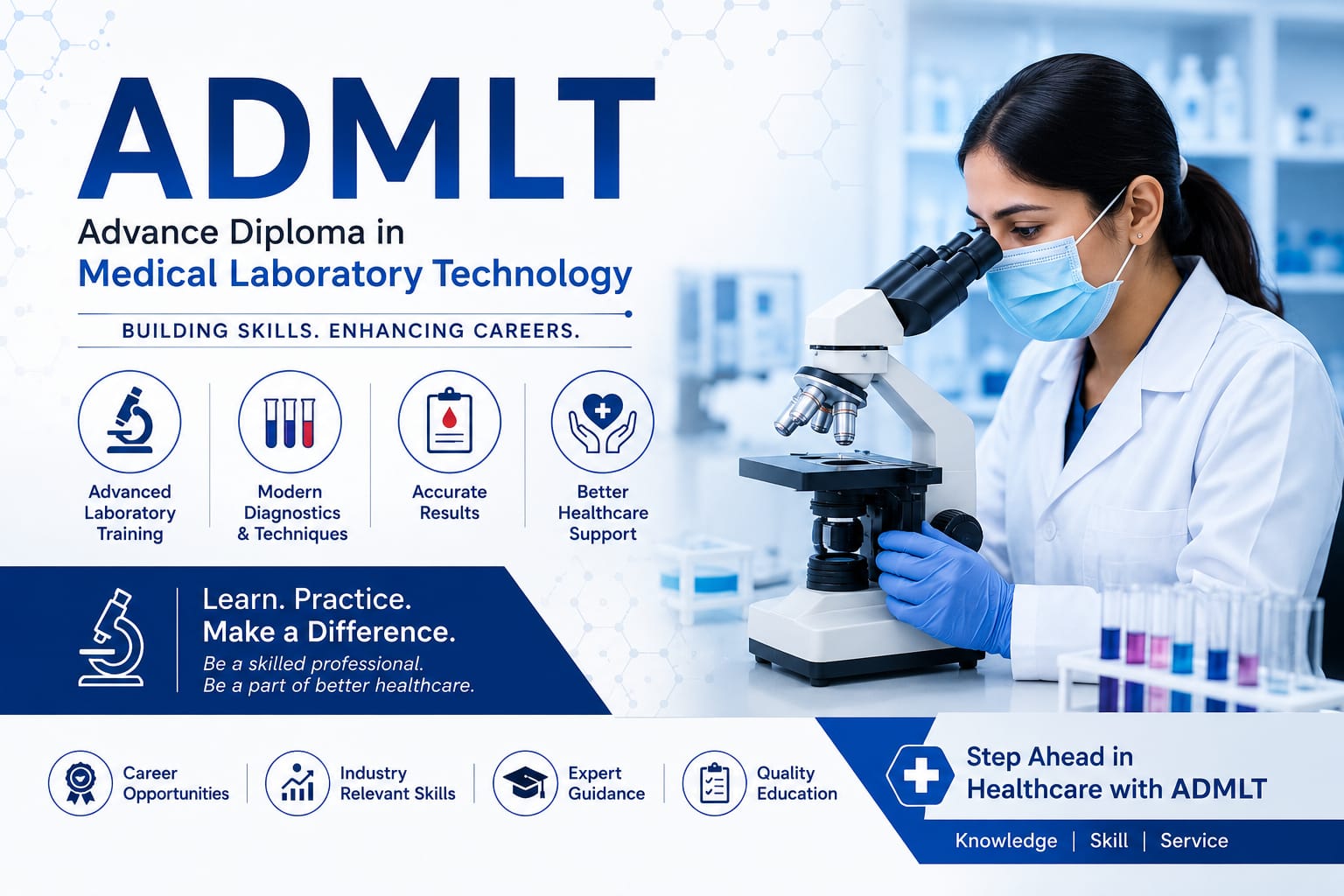 | Best Pgdmlt College Diploma Courses ADMLT-Advance Diploma in Medical Laboratory Technician Diploma Courses, Duration: 1 year 6 Month Qualification: BSc Advanced Diploma in Medical Laboratory Technology is Diploma level Medical Lab... View product → |